

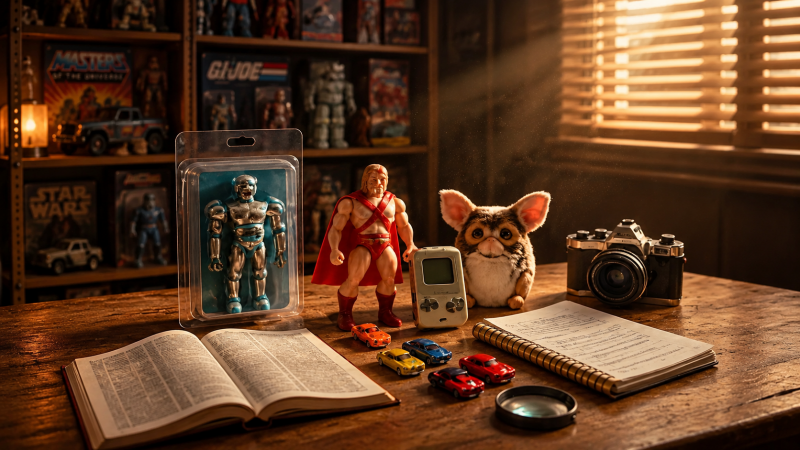
There is something magical about spotting a toy you haven't seen in 35 years.
Maybe it's a He-Man figure buried at the bottom of a flea-market box. A My Little Pony with that unmistakable pastel mane. A battered G.I. Joe vehicle that instantly transports you back to the living-room floor. Or maybe it's a Transformer you begged for every Christmas but somehow never found under the tree.
Suddenly, you're eight years old again.
That's what makes collecting toys from the 1980s and 1990s so much fun. Yes, some vintage toys can be valuable, but the best collections aren't necessarily the most expensive ones.
They're the ones that make you say:
"I HAD THAT!"
If you're ready to start collecting—or you've already accumulated a suspicious number of plastic storage bins labeled "NOT JUNK"—here's how to find, evaluate, protect, and enjoy the toys we remember.
First Rule: Collect What You Actually Love
Before worrying about price guides and rare variations, figure out what makes you nostalgic.
The 1980s and 1990s gave us an almost ridiculous number of memorable toy lines.
And that's before we get into Nintendo, Game Boy, Pokémon, Tamagotchi, and all the electronic toys that began taking over our bedrooms in the 1990s.
Trying to collect everything gets expensive—and overwhelming—very quickly.
Instead, choose a few toy lines, characters, or categories that mean something to you.
Maybe you want every original Ninja Turtle.
Maybe you're rebuilding the Barbie collection your mother gave away.
Maybe you're finally buying the Transformers your childhood allowance couldn't handle.
That's the fun part.
You're not simply collecting toys.
You're rebuilding little pieces of childhood.
Where Are All These Old Toys Hiding?
Part of the thrill is the hunt.
Vintage toys turn up in some surprisingly ordinary places, and while the internet has made collecting easier, there's still nothing quite like finding something unexpected in the wild.
Garage sales and estate sales can be treasure hunts because sellers may simply be clearing out decades of accumulated belongings.
Thrift stores are unpredictable, but that's part of their charm.
Flea markets and antique malls often have more knowledgeable sellers, which can mean higher prices—but also better selections.
Toy shows and collector conventions are particularly useful because you can inspect items in person, talk directly with sellers, and sometimes negotiate when buying several pieces.
And then there's the internet.
eBay, Mercari, Etsy, collector forums, Facebook groups, and specialty vintage-toy stores have made it possible to hunt for that one missing figure without driving through six counties every Saturday morning.
Just remember: online shopping eliminates some of the hunt, but it also makes comparison shopping much easier.
Don't Ask What They're Asking—Ask What People Are Paying
This may be the most important lesson for new collectors.
A seller can list a 1989 action figure for $900.
That doesn't mean it's worth $900.
It means someone would like $900 for it.
When researching value, look at recently sold items, not just current asking prices.
Compare examples that are genuinely similar to yours.
Is it loose or sealed?
Does it have the original accessories?
Is the packaging damaged?
Has the figure been played with?
Is it complete?
A mint-condition example still sealed on its original card can sell very differently from the same character sitting loose in a shoebox without his sword.
Condition, Condition, Condition
Collectors care about condition because these were toys.
They were designed to be opened.
Played with.
Dropped down stairs.
Buried in sandboxes.
Thrown into toy boxes.
And occasionally subjected to experiments involving markers, scissors, water, and younger siblings.
That's why exceptionally clean surviving examples can command attention.
For loose action figures, look closely at paint wear, discoloration, loose joints, broken pieces, missing accessories, stress marks, and evidence of repairs or repainting.
For boxed toys, examine the corners, cardboard, windows, tape, inserts, and overall structural condition.
Carded figures require another level of inspection. Look for creases, tears, punched-out hang tabs, yellowed plastic bubbles, cracks, dents, lifting edges, price stickers, and water damage.
A simple collector-friendly condition scale might look like:
Poor → Fair → Good → Very Good → Excellent → Mint
"Mint" should be used carefully. A toy that's "pretty nice considering my brother and I launched it off the porch in 1987" is not mint.
Complete Toys Usually Win
Remember all those tiny plastic accessories that disappeared into shag carpeting?
Collectors want them back.
Weapons, helmets, capes, shields, stands, instruction sheets, decals, vehicles, catalogs, cardboard inserts, and other original pieces can significantly affect desirability.
Some accessories are harder to find than the figures themselves because children lost them almost immediately.
Before buying an expensive loose toy, research exactly what originally came with it.
Sometimes the difference between a complete figure and an incomplete one is one ridiculously tiny piece of plastic.
Beware of Reproductions and Franken-Toys
As vintage toy prices have risen, reproduction accessories, replacement parts, custom packaging, and altered figures have become increasingly common.
Not all reproduction parts are bad.
If you simply want your childhood He-Man standing proudly on the shelf holding a sword again, a reproduction weapon might be perfectly acceptable.
The problem comes when reproduction pieces are represented as original.
Learn the identifying characteristics of expensive items before buying them. Compare paint, markings, copyright stamps, materials, accessories, packaging details, and known variations.
Be especially cautious when a deal seems dramatically cheaper than comparable examples.
Sometimes you found a bargain.
Sometimes Skeletor is up to something.
Should You Have a Toy Professionally Graded?
Professional grading makes the most sense for certain high-value, rare, or exceptionally well-preserved pieces.
Companies specializing in collectible toys can authenticate an item, evaluate its condition, assign a grade, and place it in protective packaging.
AFA—Action Figure Authority—is one of the better-known names associated with action-figure grading.
But professional grading isn't necessary for every toy.
For most personal collections, careful inspection, honest descriptions, detailed photographs, and good documentation are perfectly adequate.
Grading also costs money, so consider whether the potential benefit makes sense for the particular item.
Rare Doesn't Automatically Mean Valuable
This is another collecting trap.
Something can be rare because almost nobody bought it.
Unfortunately, sometimes almost nobody wants it now either.
Value usually comes from a combination of factors:
Scarcity + Condition + Completeness + Demand + Nostalgia
Certain variations can also matter. Retailer exclusives, packaging changes, regional releases, short production runs, errors, and unusual accessories may make one version more desirable than another.
But don't assume a variation is valuable simply because someone online calls it "RARE!!!"
Those exclamation points are free.
Protect the Toys You Worked So Hard to Find
Once you've built a collection, take care of it.
Sunlight is one of the biggest enemies of vintage toys and packaging. UV exposure can fade cardboard, discolor plastics, and damage paint.
Extreme temperatures and humidity aren't particularly friendly either.
Keep valuable pieces away from direct sunlight and damp basements, and consider UV-resistant display cases for favorites.
Acid-free storage materials can help protect paper items and packaging.
It's also smart to photograph and catalog your collection.
Record what you bought, when you bought it, what you paid, its condition, and anything unusual about the item.
Future you will be grateful.
The Most Important Collecting Rule
Don't let collecting become entirely about value.
Yes, discovering that an old toy is worth hundreds of dollars is exciting.
But there is another kind of value that doesn't appear in sold listings.
It's picking up an old figure and remembering exactly where you used to play with it.
It's finding the Barbie you opened on Christmas morning.
It's seeing the box art that once stopped you dead in the toy aisle.
It's finally buying that ridiculously awesome playset your parents absolutely refused to purchase because it cost approximately seventeen years of your childhood allowance.
Those memories are why many of us started collecting in the first place.
So visit the flea market.
Dig through the boxes.
Talk to other collectors.
Learn the strange variations.
Hunt down the missing accessories.
And build the collection you always wanted.
Because sometimes the best thing about finding an old toy isn't discovering what it's worth.
It's remembering what it meant.
Add comment
Comments